OpenAI wasn’t really a typical Silicon Valley startup in the beginning. In 2015, Sam Altman, Elon Musk, and others founded OpenAI together. Back then, AI wasn’t as hot as it is today, but Silicon Valley had already started to realize that if general AI actually emerged, it could become a technology even more fundamental than the internet or mobile computing, affecting the economy, the military, research, and even all of human society.
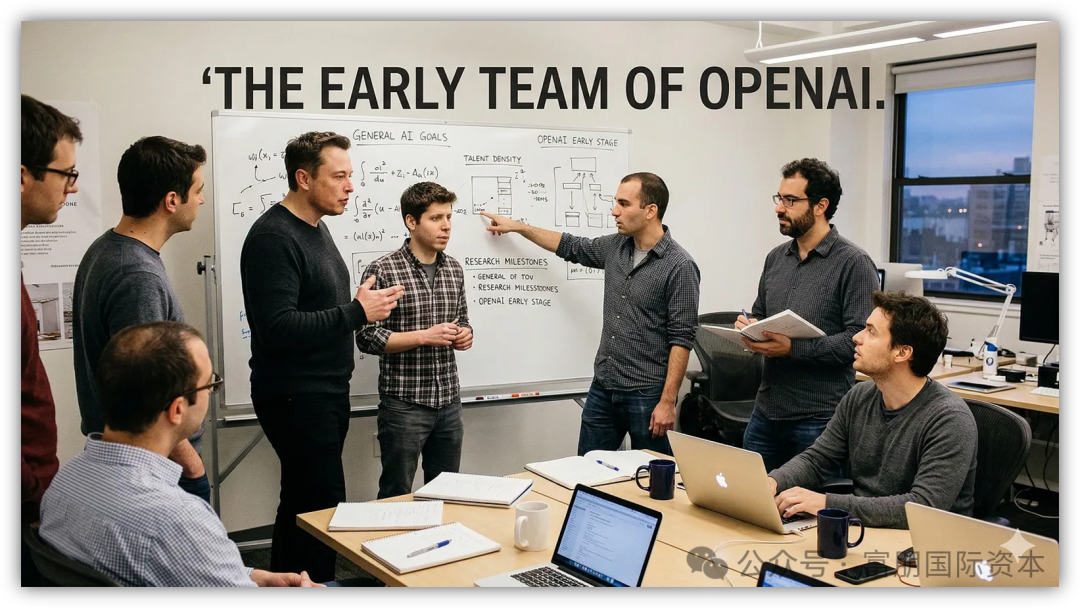
OpenAI’s early team was full of big shots; Source: Generated by Gemini AI
That’s also why it’s called OpenAI. ‘Open’ represents the ideas of openness, transparency, and sharing. In its early days, OpenAI hoped that by opening up research and technology paths, AI wouldn’t just be controlled by giants like Google, Meta, or Microsoft. In other words, the name OpenAI itself carries a strong sense of idealism: AI should be more open and serve a wider range of people.
Because of this starting point, OpenAI’s early company structure wasn’t designed around ‘founder equity incentives.’ Although Sam Altman later became the most important leader at OpenAI, he personally didn’t directly hold OpenAI shares. This arrangement was originally meant to reduce personal financial incentives and make OpenAI look less like a company driven by the founders’ interests.
But as AI model training costs skyrocketed and commercialization pressures grew, OpenAI gradually shifted from open research to a closed-source platform. Today, OpenAI’s core models aren’t open source and mostly provide services through ChatGPT and APIs. This also gives its name a kind of irony: it’s called OpenAI, but the most core technology is no longer in the ‘open’ state it once was.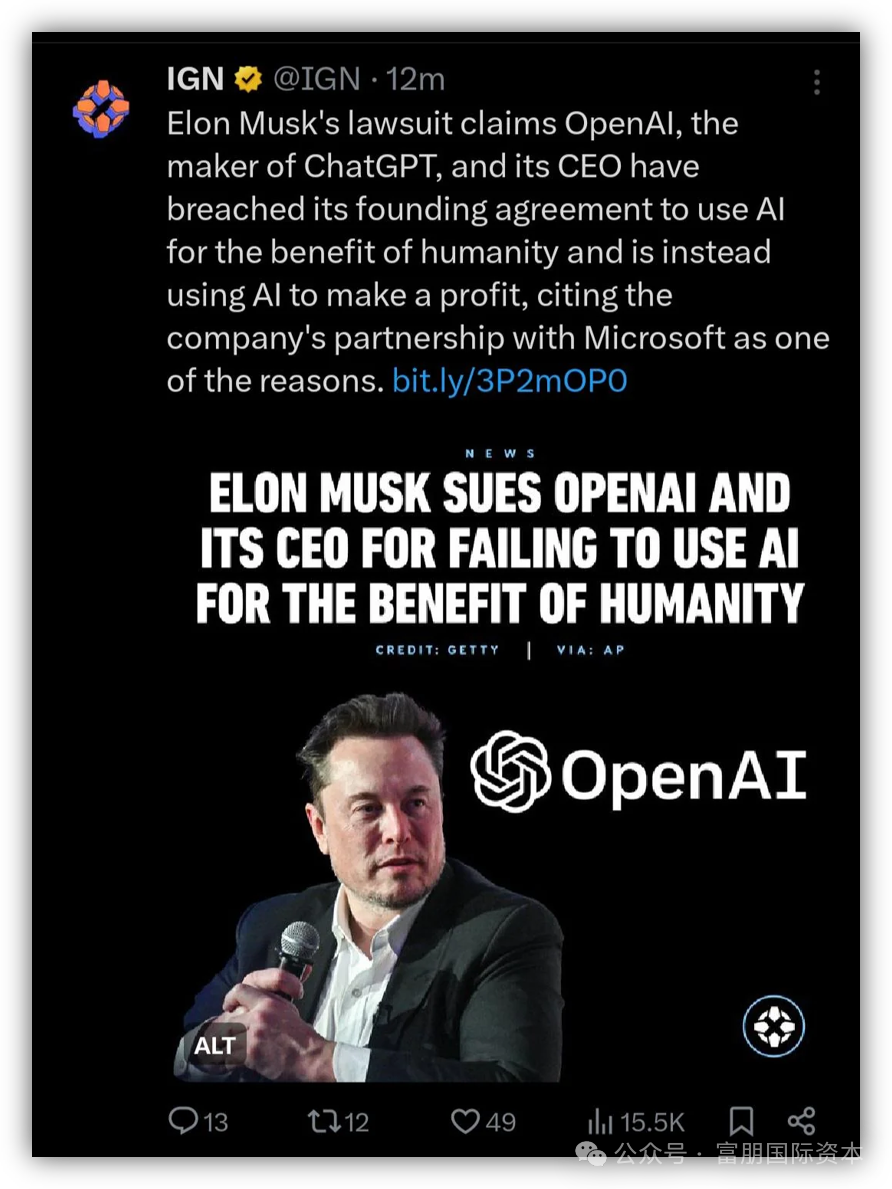
In 2024, Musk filed a lawsuit against OpenAI, accusing it of going against its original non-profit, open-source mission to benefit humanity; Source: IGN
Ten years later, OpenAI has become one of the most influential AI companies in the world. Every partnership, purchase, and investment it makes can potentially change a company’s valuation. And so, a phenomenon emerged:
Although Altman doesn’t have a stake in OpenAI, he’s using his influence at OpenAI to boost his personal investment returns.
01 How big is Altman’s investment network?
Altman has a really wide personal investment portfolio. According to the Wall Street Journal, he once mentioned having around 400 active venture projects. Based on public information and interviews, the WSJ identified over 80 of these companies, many of which go back to his time as president of Y Combinator.
These companies are spread across several areas:
-
Enterprise software
-
Biotech and healthcare
-
Chips and energy
-
Fintech
-
Aerospace
And other tech startup projects.
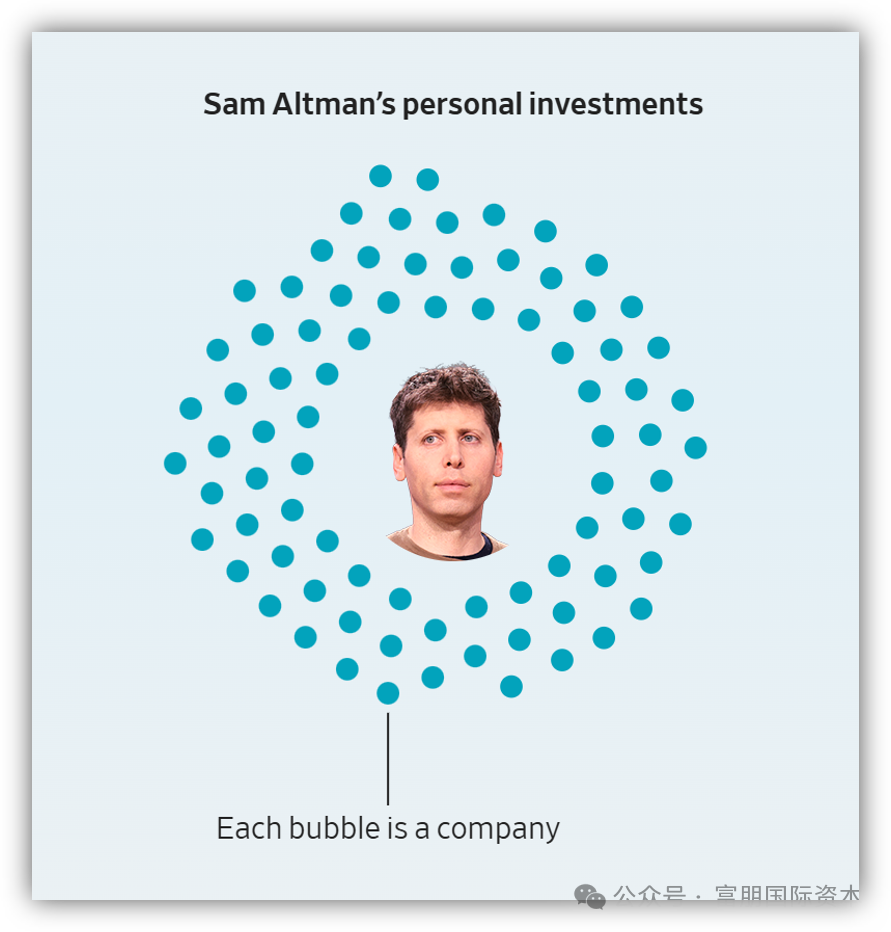
The Wall Street Journal found over 80 companies connected to Sam Altman, with each little dot representing a connected company; Source: WSJ
On the surface, these investments seem pretty spread out. But if you look at today’s AI industry chain, many of them can actually connect with OpenAI – OpenAI needs computing power, so chip companies benefit; OpenAI needs long-term, stable, low-cost energy, so renewable energy and nuclear fusion companies get attention; OpenAI might also get into drug research and life sciences, so biotech companies could have collaboration opportunities too.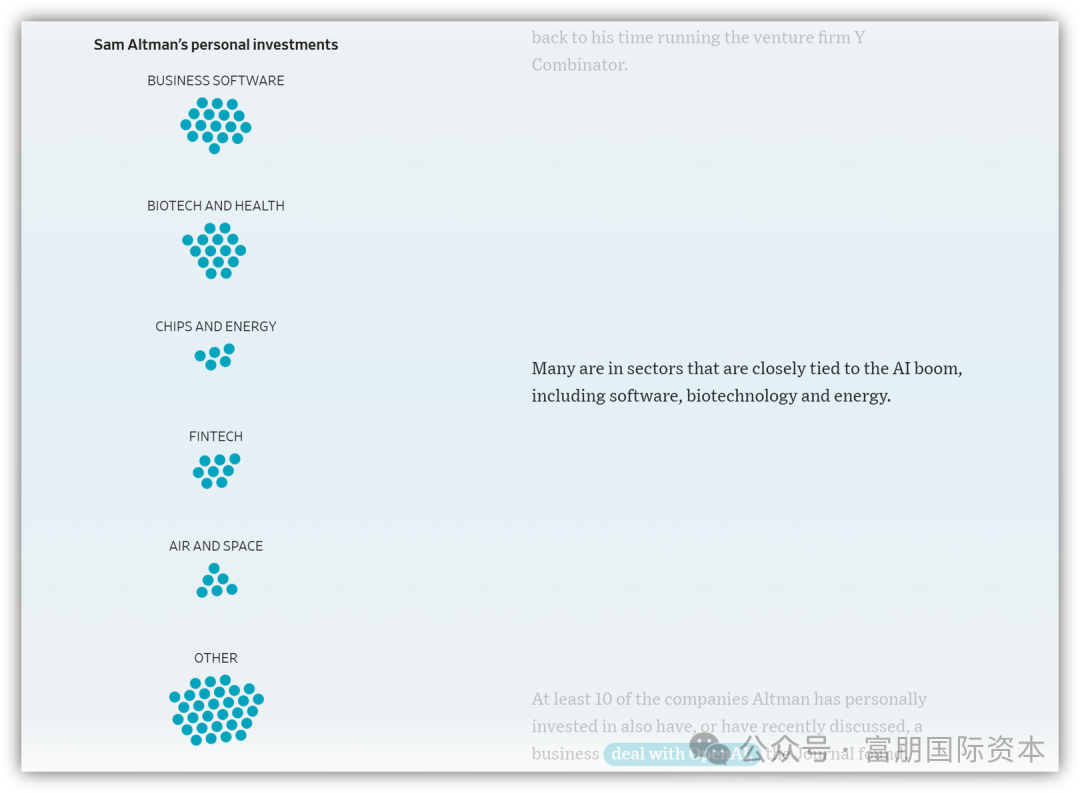
The industries Sam Altman invests in are mostly related to AI; Source: WSJ
The WSJ mentioned that at least 10 companies personally invested in by Altman have either partnered with OpenAI or have recently discussed potential collaborations. This makes Altman’s role pretty complicated. He’s not an OpenAI shareholder, but he is a shareholder in many potential partners of OpenAI.
02 OpenAI is becoming a ‘valuation amplifier’
If Sam Altman directly owned shares in OpenAI, the conflict of interest would be pretty clear: if OpenAI’s valuation goes up, he benefits. The issue now is more complicated. OpenAI has become one of the most influential companies in the AI industry. It’s not just a client anymore; it’s more like an industry stamp of approval. Whoever can work with OpenAI might get a revaluation in the capital market.
-
For chip companies, OpenAI buying their products means their technology is validated by a top client.
-
For energy companies, OpenAI signing the deal means it might need AI data centers in the future.
-
For biotech companies, partnering with OpenAI means they could jump on the main track of AI research.
So, when OpenAI’s partner happens to be a company that Altman personally invested in, people naturally ask: Is this deal what OpenAI really needs, or is it just helping Altman’s own investment grow?
03 Helion: The Most Typical Controversial Case
Helion is a nuclear fusion startup and also one of the projects that Altman personally pays the most attention to.
This case is sensitive because several factors overlap:
-
Altman is the CEO of OpenAI;
-
Altman is also an important investor in Helion.
-
OpenAI will need a lot of electricity in the future;
-
Helion is talking about the next-generation energy story.
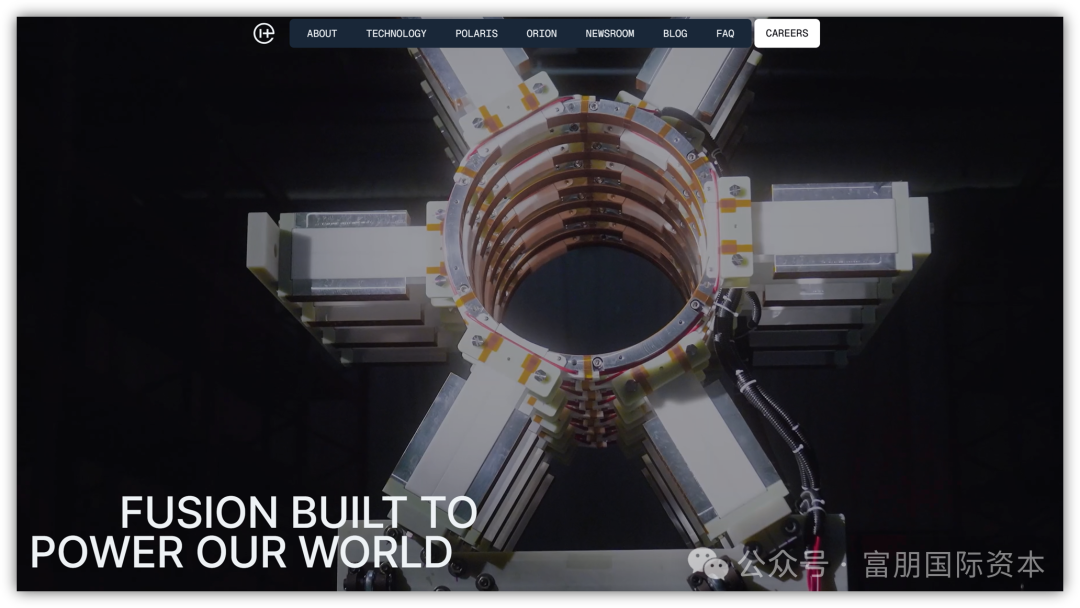
A conceptual prototype of Helion’s controllable nuclear fusion facility; Source: Helion
- In 2015, Altman invested in Helion and became its chairman. That same year, he also helped co-found OpenAI.
- In 2021, Altman continued pouring money into Helion. The WSJ mentioned that he invested $375 million in Helion that year, which was his largest personal check to a startup at the time.
- In 2024, OpenAI and Helion reached a non-binding power purchase agreement, planning to buy Helion’s electricity in the future.
- In 2025, Altman pushed SoftBank to invest in Helion. The WSJ also mentioned that he suggested OpenAI invest about $500 million in Helion, but OpenAI ultimately didn’t.
- In 2026, OpenAI and Helion signed a revised agreement. Altman stepped down from Helion’s board that same month, citing potential future collaborations with OpenAI. After that, Helion got investment from Thrive Capital, with a valuation of $15.5 billion. WSJ said Altman’s stake in Helion was now worth at least $4.1 billion.
The thing that’s hardest for outsiders to ignore is: OpenAI’s partnership with Helion might make sense for the industry, but Altman, as a Helion shareholder, is also benefiting from Helion’s rising valuation.
04 Cerebras: The IPO Boost from OpenAI’s Purchase
AI chips are one of the core parts of OpenAI’s supply chain. For any chip company, landing a client like OpenAI is a really strong market signal. The WSJ mentioned that OpenAI recently agreed to buy chips from Cerebras. This deal helped Cerebras pull off a very successful IPO and also made Altman’s stake in Cerebras grow more than six times compared to last December.
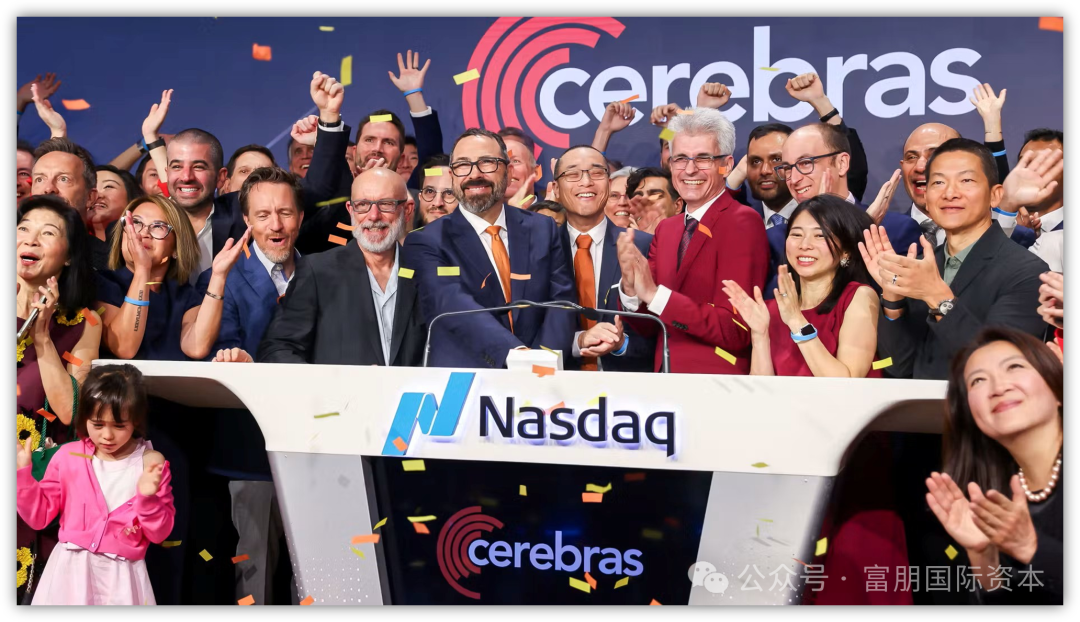
In May 2026, Cerebras went public on Nasdaq through an IPO; Source: Nasdaq
The impact of these kinds of deals isn’t just about order revenue. More importantly, just having OpenAI as a customer is a kind of endorsement. The capital markets might think: if OpenAI is willing to buy their chips, it probably means the company’s technology is actually competitive, and its path to commercialization seems more reliable. And Altman, as an early investor, will naturally benefit from this boost in valuation.
05 Retro Biosciences: AI Enters Life Sciences
Another case is Retro Biosciences. It’s a startup focused on life sciences and longevity, and Altman is also an investor.
The WSJ mentioned that after Altman invested, OpenAI had research collaborations with at least two biotech companies. Retro Biosciences was specifically named. According to evidence revealed in Musk’s lawsuit related to OpenAI, Altman’s stake in Retro Biosciences was worth about $258 million as of last December.
This direction itself isn’t unusual. AI models can be used for drug development, protein design, genetic research, and experiment process optimization. OpenAI moving into life sciences makes a lot of sense from an industry perspective. But the issue remains the same: if OpenAI’s partners happen to be companies that the CEO personally invests in, the market can’t easily ignore potential conflicts of interest.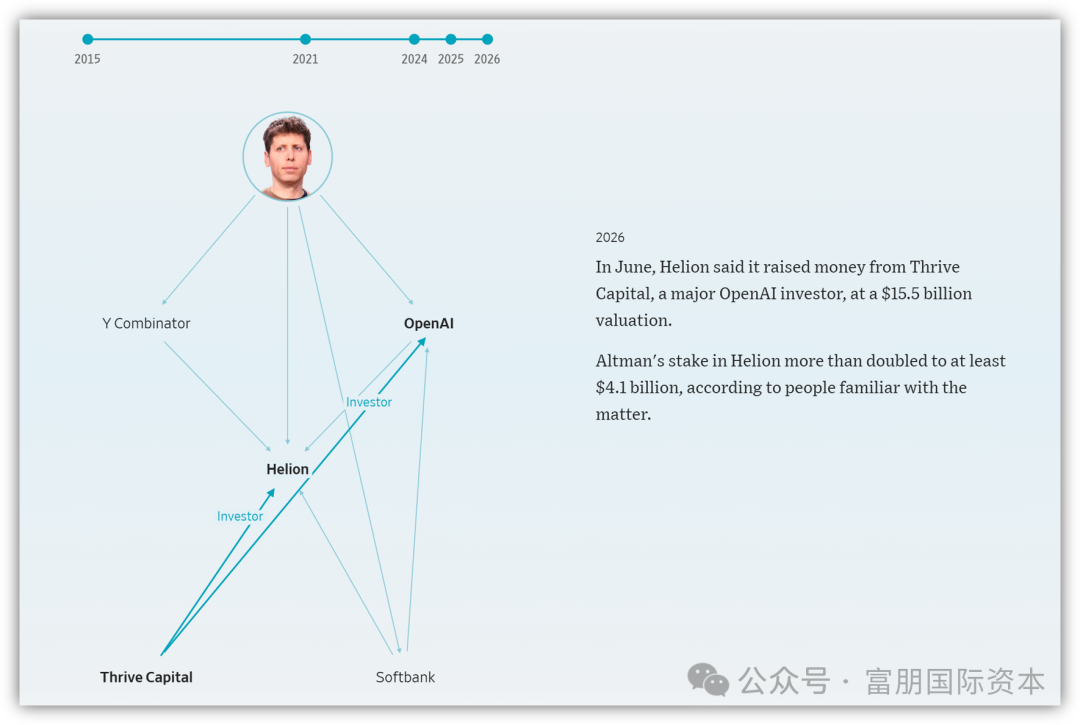
WSJ revealed that Altman indirectly doubled the value of his own assets through OpenAI’s investors; Source: WSJ
06 Why has this become a sensitive issue now?
In the past in Silicon Valley, it wasn’t uncommon for founders, investors, and startups to overlap. One person could invest in a company, make introductions, and push for partnerships—it was actually quite common in the startup world. But OpenAI is no longer an ordinary startup. Every collaboration, purchase, and investment it makes can affect the flow of resources across the entire AI industry chain and also change how the capital market values related companies.More importantly, if OpenAI continues toward an IPO in the future, it will be scrutinized by the market more like a publicly listed company. Investors won’t just look at model capabilities, revenue growth, and valuation—they’ll also be looking at:
-
Does the company have a proper review process for related-party transactions?
-
Did Altman recuse himself from the relevant decision?
-
Is the board really independent?
-
Have these potential conflicts of interest been fully disclosed?
So on the eve of OpenAI going public, The Wall Street Journal raised this question, hoping OpenAI could prove that even though Altman has a huge portfolio of external investments, OpenAI’s business decisions aren’t made to take care of his personal assets.